


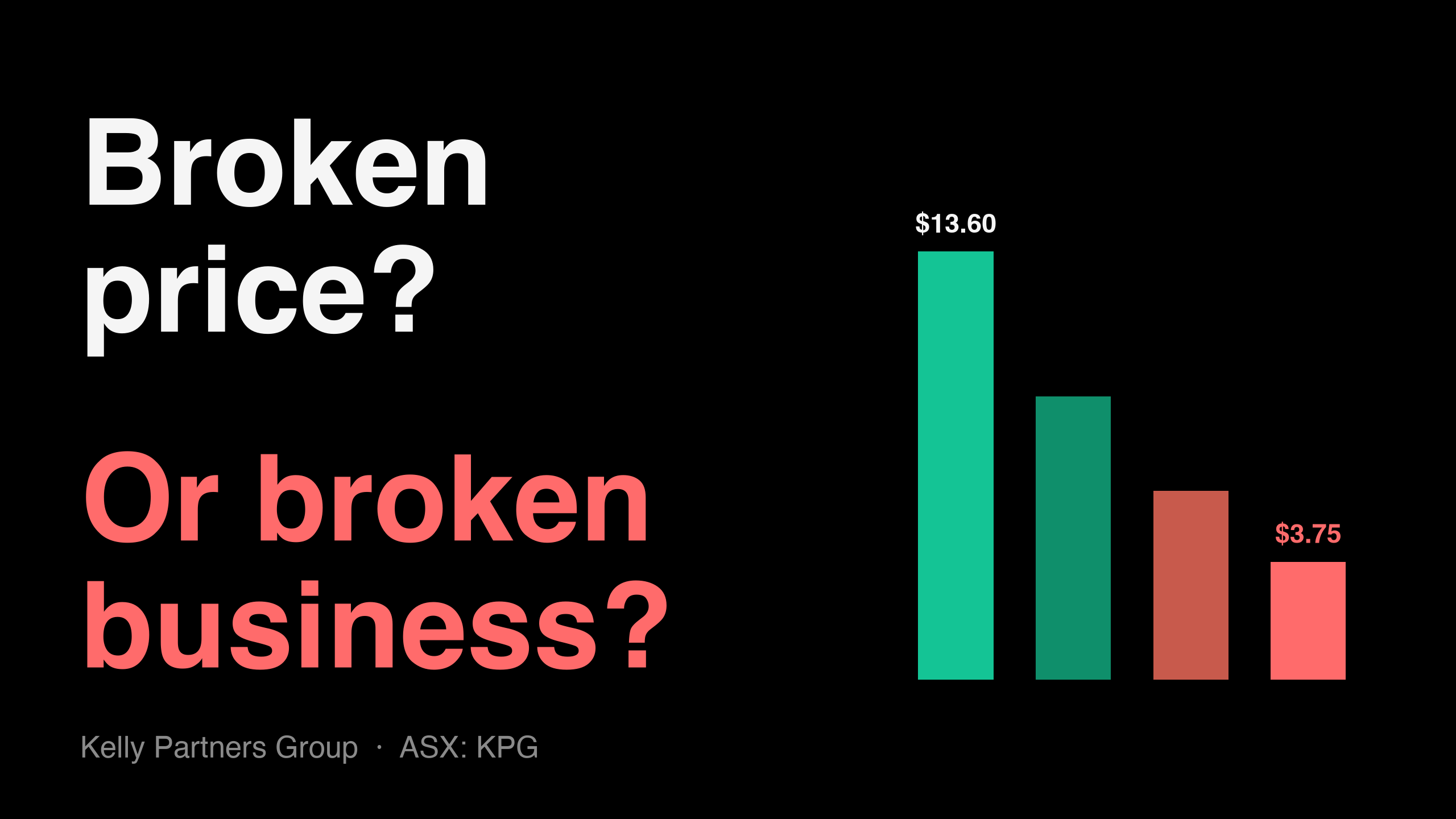
When we last wrote up Kelly Partners Group in March, the stock was around six dollars, the newsletter community was calling it a compounder, and we were the ones raining on it. Our verdict was Cautious. We argued the business was genuinely good but the price was pricing a great one, put fair value at four dollars fifty to five dollars fifty, and closed with a single line: trust the earnings.
The earnings were right. The stock is now three dollars seventy five, down another forty percent from where we wrote and roughly seventy two percent from its February 2025 high. It has fallen straight through our fair value band and is sitting near its 52-week low.
That is not a victory lap, because being right on the way down only matters if it tells you what to do next. And here is where it gets interesting. The same discipline that kept us out at six dollars now points at a harder, more useful question. At three dollars seventy five, below where we said fair value sat and below the analyst consensus target, is this a broken price on a business that still works, or a business that is quietly breaking? The honest answer is not the same for both halves, and separating them is the whole job.
What we said, and what the market did
Our case in March was simple. Revenue was compounding but statutory earnings were not. The company led with an adjusted metric, NPATA, that strips out acquisition amortisation, which is the single largest real cost of a business whose entire model is buying other businesses. Organic growth was four percent. The multiple was extreme. We valued it on the measure that survives contact with reality, cash earnings and enterprise value, not the narrative, and got a number well below the price.
Since then the market has done the work for us. The February half-year result landed with revenue up seventeen percent to seventy six million, which looked strong on the headline and drew the usual applause. Underneath it, statutory profit attributable to KPG shareholders fell about fifteen percent, statutory earnings per share dropped from five point six cents to four point seven, and the operating margin compressed. A brutal single week in early February took the shares down about twenty seven percent and drew a price query from the exchange, which the company answered by saying it was aware of no undisclosed information. The slide continued from there.
So the perfection premium we warned about has now been paid back in full. The question is what is left once it is gone.
The price has actually reset
Start with the fact that matters most and gets lost in the drama of a seventy two percent fall: the valuation is no longer the problem.
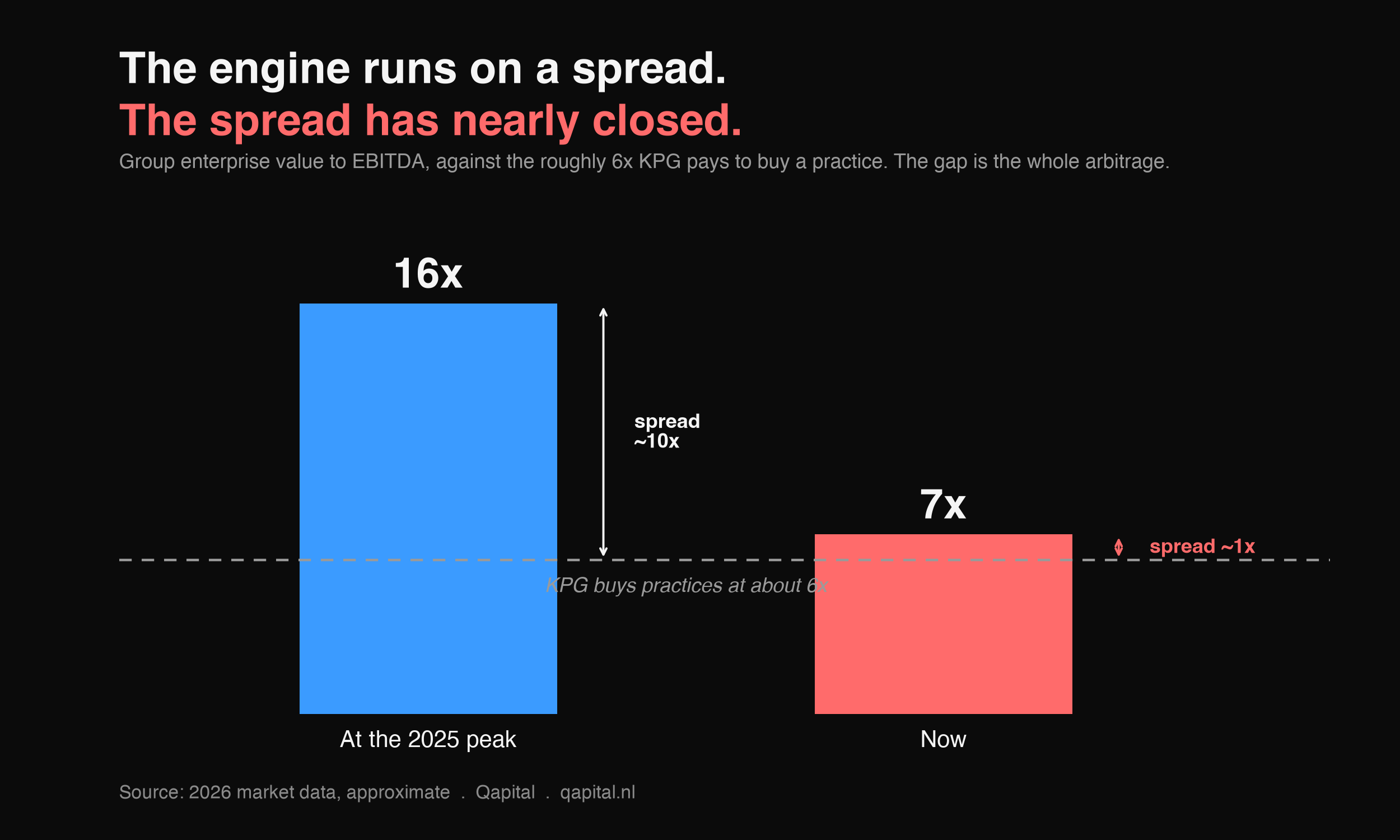
At the peak the market valued the whole enterprise at close to sixteen times underlying EBITDA. Today, at three dollars seventy five with net debt of about seventy seven million, the enterprise trades at roughly seven times. That is not a compounder multiple. It is a fair-to-cheap multiple for a professional services business, in the range private equity buyers pay for similar assets, and it is close to the level our own bear case used to derive fair value back in March. On enterprise value to EBITDA, the stock has done what we said it would and arrived where we said it belonged.
The trailing price to earnings ratio, by contrast, still looks frightening at around fifty seven times, and this is exactly the trap our first piece warned about, now running in the other direction. Price to earnings is the wrong lens for Kelly Partners. The company consolidates all the revenue of practices it only owns fifty one percent of, carries heavy amortisation from every deal it has ever done, and reports a statutory profit that is a thin residual at the bottom of all that. A fifty seven times headline tells you almost nothing about what you are paying for the cash the business actually throws off. Enterprise value to EBITDA, at seven times, tells you far more, and it says the price has reset.
If the story ended there, this would be an upgrade to a buy. It does not end there.
A cheaper multiple is not a cheaper risk
A falling stock is not the same as a cheap one. Cheap requires the denominator to hold, and at Kelly Partners the denominator is still moving the wrong way.
The measure we told you to trust, statutory earnings attributable to shareholders, is still falling, and here the accounting matters because it is the whole point. Total group profit was down only about five percent in the half, and a casual reader stops there and relaxes. But Kelly Partners consolidates the full results of practices it owns barely half of, and once the operating partners take their share, non-controlling interests claimed about seventy four percent of group profit. The slice left for KPG shareholders fell about fifteen percent, from two point five million to two point one million, on a seventeen percent rise in revenue. Read that again, because it is the entire tension in the business. The company is getting much bigger and slightly less profitable at the same time. The operating margin gave back more than a point in the half. The organic growth rate, the part of the business that is not bought, is still about four percent, which after Australian inflation is close to flat.
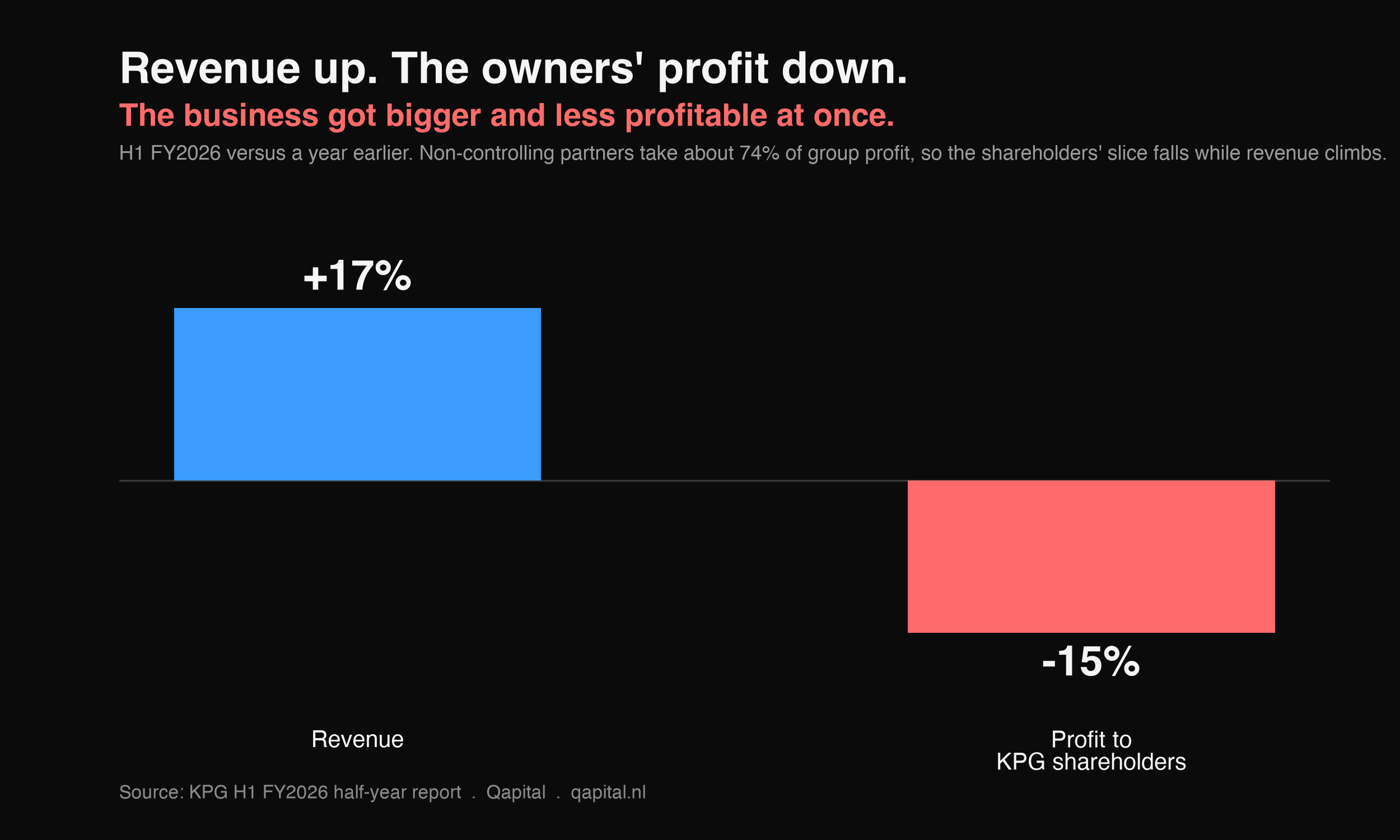
So the multiple has come down, but so have the earnings it sits on, and they have not yet stopped coming down. That is the difference between a broken price and a broken business, and on the reported numbers you cannot yet say which one this is. The price has corrected. The proof that the business has stabilised is not here.
The flywheel runs on a spread, and the spread has nearly closed
Here is the point that a seventy two percent chart hides, and it is the most important one for anyone who wants to understand buy-and-build as a model rather than a story.
Kelly Partners buys accounting practices for around six times their cash earnings. At the peak, the market then valued those same earnings, sitting inside the listed group, at close to sixteen times. That gap is the entire engine. Buy a dollar of earnings for six, have the market immediately revalue it at sixteen, and you have created value out of the transaction itself, before a single operational improvement. Every serial acquirer that has ever compounded, Constellation included, runs on some version of this spread between the private price paid and the public multiple awarded.
At seven times, that spread has almost gone. When the group trades at seven and it still pays six for practices, the arbitrage that powered the compounding is nearly closed. The market is no longer paying Kelly Partners a premium to go out and acquire. This is not a temporary sentiment problem. It is the mechanism of the model losing its fuel. The company can still buy good businesses and improve them, but the free lift it used to get simply from being listed at a high multiple is gone until the multiple recovers, and the multiple will not recover until the earnings do. That is a chicken-and-egg the bulls have not priced.
What is new since we wrote: the flags
Three things have changed since March, and all of them point the same way.
Leverage has climbed. Net debt rose about eighteen million in a single half to seventy seven million, roughly one point eight times underlying EBITDA, to fund acquisitions and partner buy-ins. That is not alarming in isolation, but it is rising while statutory earnings fall, which is the wrong combination, and the group spent part of the year formally locking down its debt security through a shareholder-approved subsidiary guarantee arrangement.
The founder has borrowed against his own stake. Brett Kelly, the roughly forty seven percent owner whose alignment is central to the entire bull case, restructured his shareholding under new loan security arrangements disclosed in director interest notices this year, pledging KPG shares as collateral for personal borrowings. Founder ownership is a strength. Founder ownership pledged as loan collateral into a falling share price is a different thing, because it introduces the possibility of forced selling at exactly the wrong moment, and it slightly changes what his alignment actually means.
And the dividend, which our first piece should have stressed more, has not been paid since early 2024. A business that is retaining all its cash and still watching statutory earnings fall is telling you the cash is going into the acquisition machine and the debt, not into returns to owners.
How much of this is even KPG’s fault
A fair update has to separate the company from its sector, because a good part of the fall is not about Kelly Partners at all.
Serial acquirers and anything touching accounting compliance were de-rated hard across 2026 on the fear that artificial intelligence will automate the routine work. This is not a small-cap curiosity. Constellation Software, the gold standard of the model and the name Kelly Partners literally puts on its own strategy slides, fell around fifty percent from its highs on the same fear while its earnings kept growing. H and R Block traded near multi-year lows. The compression that took Kelly Partners from sixteen times to seven happened to the whole category, which means a chunk of the pain is a repricing of the sector, not a verdict on this company.
The AI question itself is more balanced than either camp admits. The professional consensus in 2026 is that AI automates tasks, the low-value compliance and data entry, while the value migrates to advisory and judgment. That is a margin and mix problem, not demand destruction, and it is survivable for firms that make the pivot. Australia adds a genuine offset the bears ignore: a wave of new regulation landing in 2026, anti-money-laundering obligations extending to accountants and payday superannuation both taking effect from the first of July, is actively increasing the compliance workload. Complexity creates demand for accountants. That is real, and it is a tailwind.
But here the company earns its own share of the blame. In a year when the entire market is asking one question about its sector, Kelly Partners did not mention artificial intelligence at all in its latest results. Management’s silence on the single issue driving its multiple is not a good look, and it is the sort of thing that lets a sector de-rating become a company-specific discount.
Broken business or broken price?
Put the two halves together honestly.
The price is no longer the reason to stay away. At seven times EBITDA the perfection premium is gone, the stock sits below both our old fair value band and the analyst consensus target, and part of the fall is a sector repricing that overshot on a good business. On valuation alone, the argument that took us out at six dollars does not hold at three seventy five.
The business, though, has not yet proven it has stabilised. Statutory earnings are still falling, the margin is still compressing, organic growth is still four percent, leverage is rising, the founder is borrowed against his stake, and the multiple arbitrage that powered the whole model has nearly closed. None of that makes it a broken business. A twenty percent return on invested capital and a genuinely differentiated partner-owner structure are still there. But cheap only pays you if the earnings hold, and the earnings are still going the wrong way.
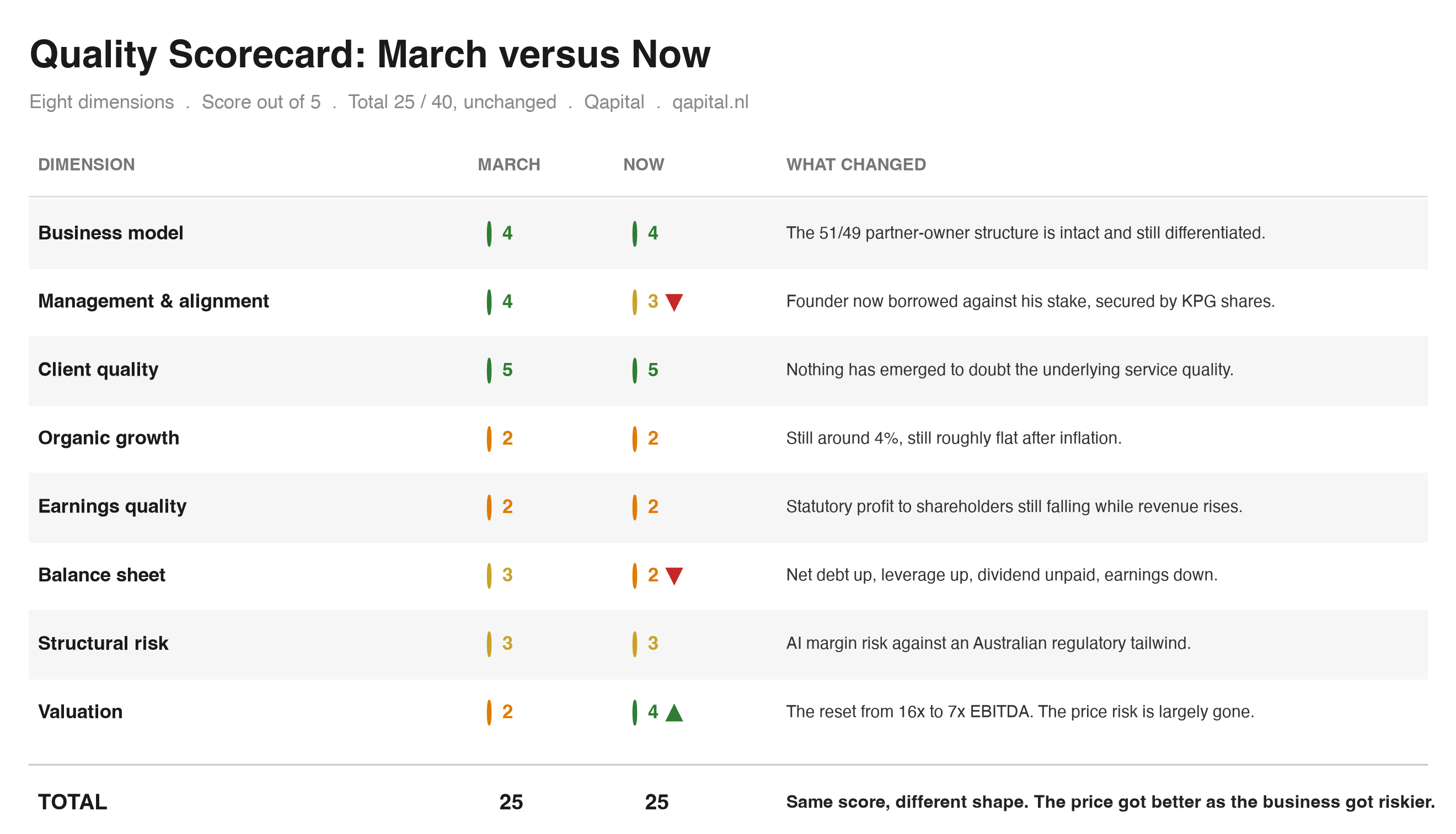
So the honest verdict is a split one, and it is a genuine change from March. We are no longer negative on the price. We are now agnostic on the business, waiting for one specific piece of evidence. That is an upgrade from Cautious to Neutral, and it is the first time this stock has been interesting to us on the long side rather than the short.
The line in the sand
The evidence arrives in about six weeks. Kelly Partners reports its full-year result for the year to June around late August, and it is the cleanest test this thesis will get.
Watch three things, in order. First, statutory profit attributable to shareholders, not NPATA, not run-rate revenue: does the fifteen percent decline stop, or does it continue. Second, the operating margin: does it stabilise near its recent level or keep leaking, because a bought-growth business that is also losing margin is destroying value no matter how fast revenue climbs. Third, the organic growth line: any move from four toward the five percent management keeps promising would be the first hard sign the upsell story is real.
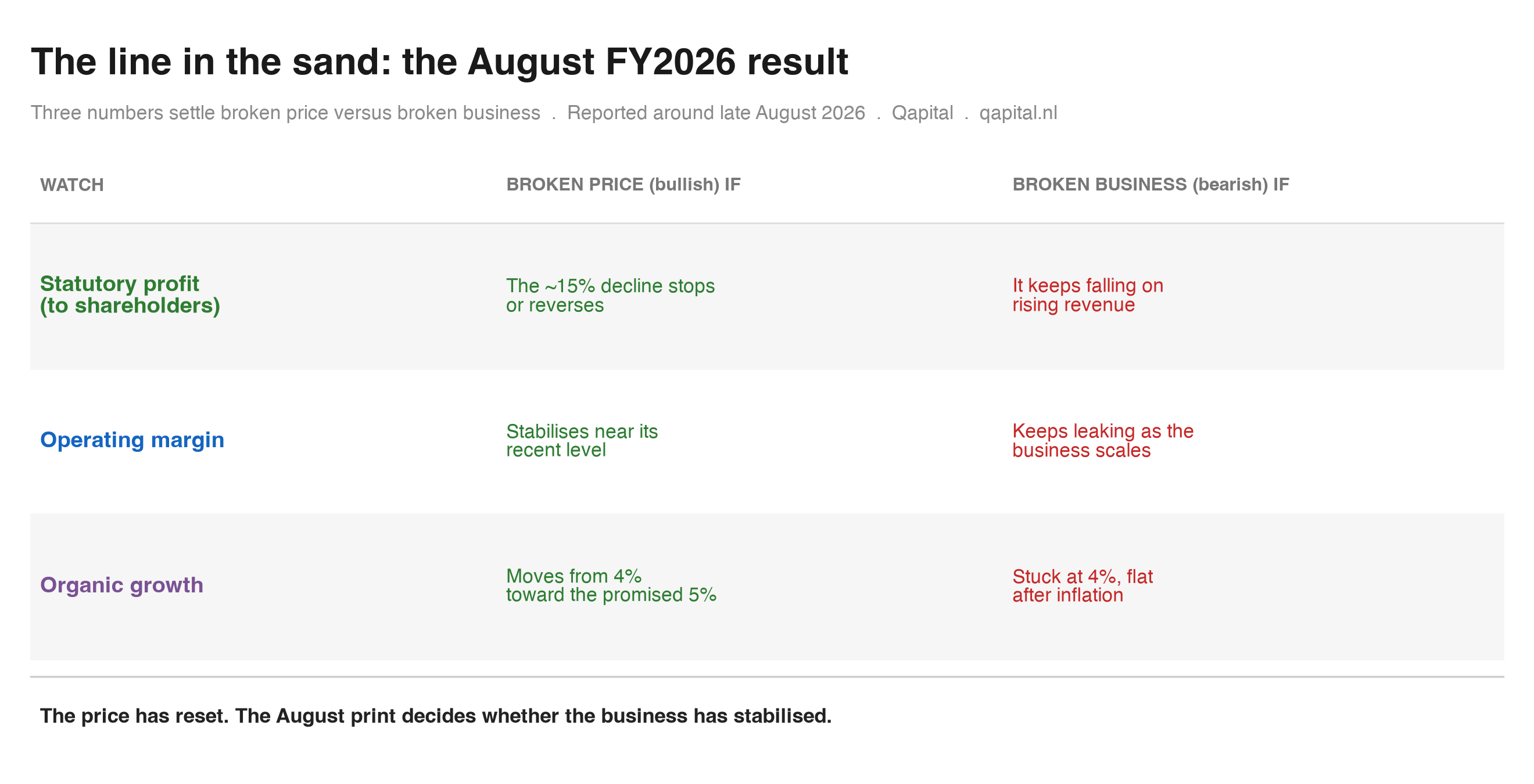
If those three hold, then this is a broken price on an intact compounder, and three dollars seventy five will look like the moment the perfection premium finished unwinding and left a fair business at a fair price. If statutory earnings keep falling and leverage keeps climbing into a closing multiple arbitrage, then it is a broken business, cheap is not cheap enough, and the sector will have been right to mark it down. We would rather wait six weeks and know than guess now and hope.
The narrative told you this was a compounder, and the earnings told you otherwise. That was the trade in March. In August, the earnings get to speak again, and this time we are listening for the opposite answer.
Updated scorecard versus March
Sources and Disclosures
This is a follow-up to our March 2026 note on Kelly Partners. Figures are drawn from the company’s H1 FY2026 half-year report (half to December 31, 2025), its February 2026 response to the ASX price query, director interest notices filed in 2026, and 2026 market data from early July. Full-year FY2026 results are pending and expected around late August 2026. Some market-data figures, including the current enterprise value to EBITDA multiple, rest on third-party sources and are approximate.
This article is research and opinion for general information. It is not personalised investment advice, an offer, or a solicitation. Small-cap equities carry significant risk, including the permanent loss of capital. Do your own work and size positions accordingly. All figures in AUD.