


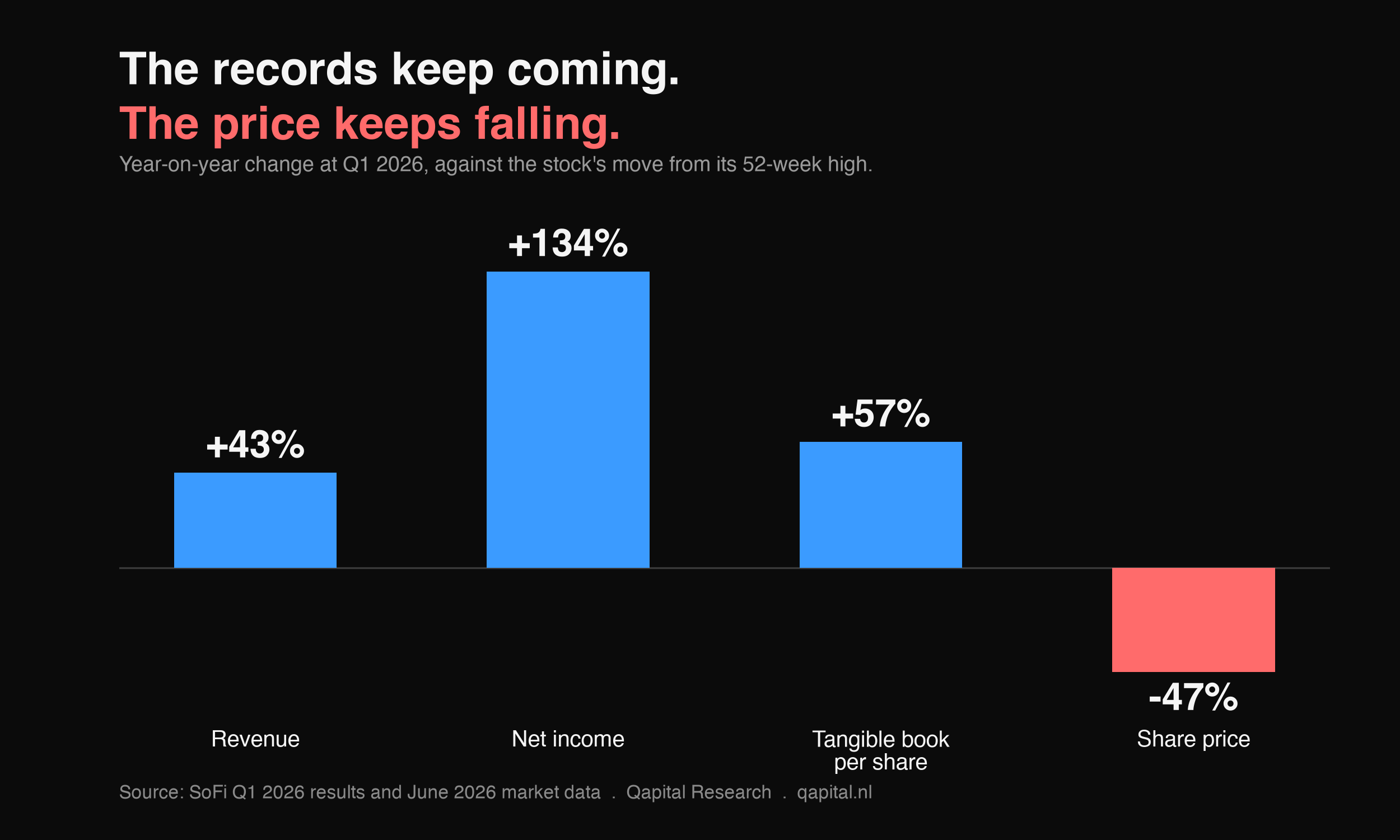
SoFi just reported the best quarter in its history. Record revenue of $1.1 billion, up 43 percent. Net income of $167 million, the tenth consecutive profitable quarter. Tangible book value per share up 57 percent in a year. A capital ratio nearly three times the regulatory minimum. And over the same stretch the stock has fallen roughly 47 percent from its high.
That gap is the entire story. When a business posts records and the price collapses anyway, one of two things is true. Either the market sees something the income statement does not, or the market has confused a change in mood with a change in fundamentals. This piece argues it is mostly the second, while taking the first possibility seriously enough to tell you exactly where the thesis breaks.
What SoFi actually is now
It is easy to remember SoFi as a student-loan refinancing app that went public through a blank-check deal in 2021 and lost money for years. That company no longer exists. SoFi holds a national bank charter, funds itself with more than 40 billion dollars of customer deposits, and runs three businesses at once.
Financial Services is the deposit, checking, brokerage, and credit-card franchise, plus the fee engine. It produced 428 million dollars of revenue in the quarter, up 41 percent, at a 46 percent contribution margin. Lending is the original business, now far larger and broader, covering personal, student, and home loans. It produced 642 million dollars of revenue, up 55 percent, at a 60 percent contribution margin. Technology Platform is Galileo, the behind-the-scenes infrastructure that other fintechs and banks run their accounts on. It produced 75 million dollars and, unlike the other two, it shrank.
The shape matters. A year ago SoFi was a lender with some side businesses. Today the deposit franchise and the fee lines carry real weight, and the company funds its own loans with its own deposits instead of renting money from warehouse lenders. That single structural change is why the profitability is real and not an accounting artifact.
Why the stock fell
The decline was not one event. It was four, stacked on top of each other over a few months.
First, the valuation reset. SoFi entered 2026 priced for perfection after a very strong 2025. When the Federal Reserve paused instead of cutting, the market repriced rate-sensitive lenders downward, and a stock trading at a rich multiple had the furthest to fall.
Second, on March 17 the short-selling firm Muddy Waters published a report alleging that SoFi was hiding debt, overstating profitability, and understating its true loan losses. These are allegations, not findings. SoFi rejected them the same day as factually inaccurate, and the chief executive bought shares into the decline. But a detailed short report does its damage on the way to being disproven, not after.
Third, the investor Steve Eisman publicly questioned SoFi’s exposure to loan securitizations, pointing to loss data on one bond pool. This is securitization-level data that can look worse than the loans SoFi keeps on its own books, but it added to the credit fear.
Fourth, on April 29 SoFi reported those record results and the stock fell anyway, because management held full-year guidance flat after a clear beat and because the Galileo segment revenue dropped 27 percent. The market wanted a guidance raise, did not get one, and sold.
None of these four is about the core business getting worse. Three are about sentiment, valuation, and a contested narrative. The fourth, Galileo, is a genuine operational issue we deal with directly below.
The credit question, answered with the actual numbers
This is the heart of the bear case, so it deserves the most precision. The fear is simple: SoFi lends to consumers, the consumer is stretched, and a bank that is hiding rising losses is a value trap.
Here is what the filing shows. The annualized net charge-off rate on personal loans was 3.03 percent in the quarter. That is down 28 basis points from a year earlier, but up from 2.80 percent in the prior quarter. The bear stops at the sequential increase. The full picture is more specific than that. SoFi sells some late-stage delinquent loans rather than charging them off itself, and the timing of those sales moves the headline rate quarter to quarter. Including recoveries and excluding those late-stage sales, the all-in loss rate was roughly 4.4 percent, consistent with the prior quarter. The 90-day delinquency rates on both personal and student loans were in line with the prior year.
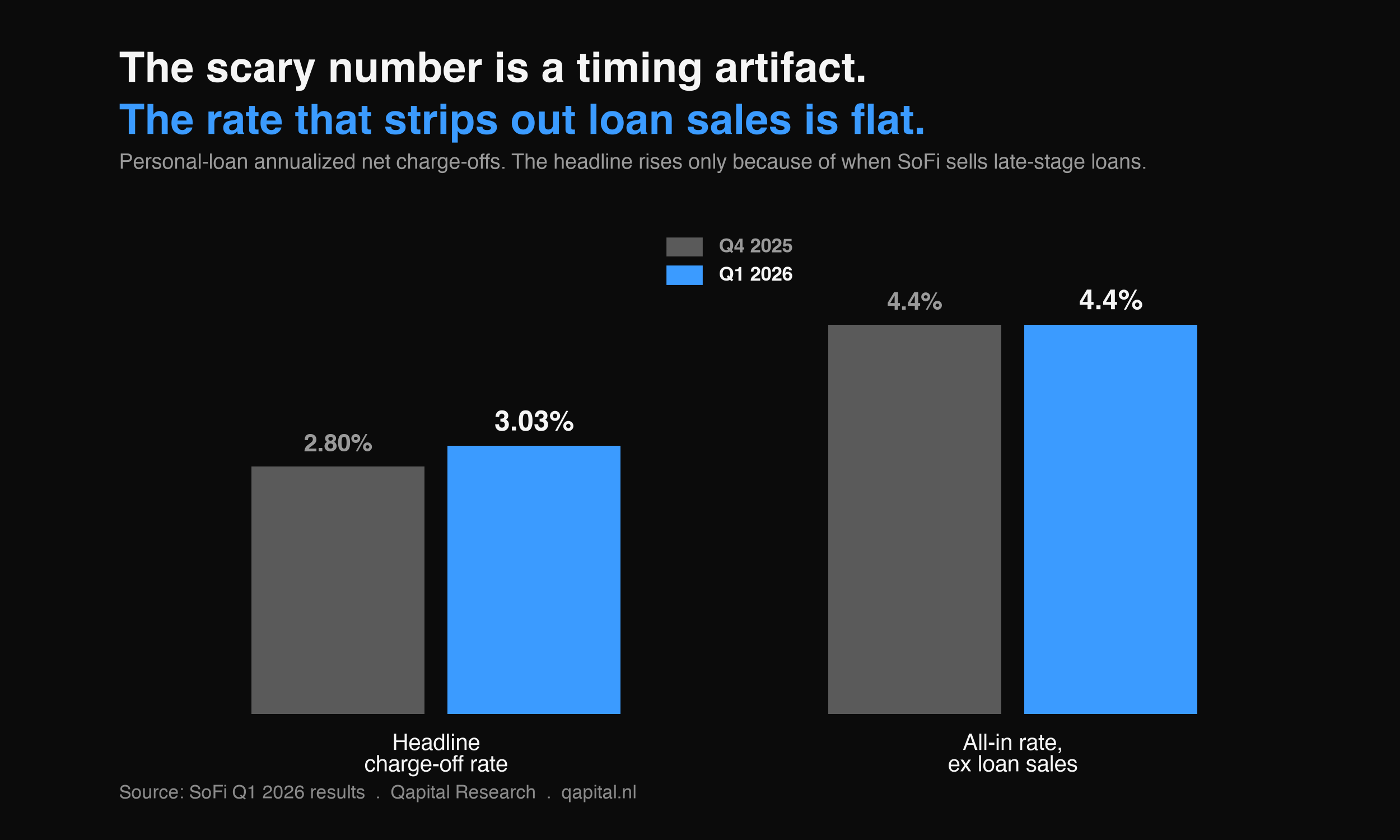
So the honest read is this. Reported credit was generally stable in the quarter. Charge-offs were down year over year, delinquencies were in line with last year, and the all-in loss rate held flat. It is not bulletproof, because the headline rate is genuinely flattered by selling delinquent loans before they default, and that loan-sale effect is exactly why the number warrants monitoring rather than a clean all-clear. A true downturn would show up here first. The Muddy Waters claim of a roughly 6 percent real loss rate is the aggressive version of a fair question. The answer is not yes and not nothing. It is that the loans SoFi keeps are performing in line with last year, and the place to confirm or break that is the next print.
That is why this is a buy with a line in the sand, not a buy with a closed case.
Galileo, the one thing that really did get worse
Technology Platform revenue fell 27 percent, contribution profit fell 61 percent, and enabled accounts fell 16 percent. This is real and it is not a sentiment story. The cause is concentration: a single large client wound down its use of the platform and fully transitioned off before the end of 2025. When one client is big enough to swing a segment by a quarter of its revenue, that segment was more fragile than the growth story implied.
The bull answer is that Galileo is now the smallest of the three segments, roughly 75 million dollars of revenue against more than a billion in total, so a bad quarter there does not break the company. The bear answer is that it was supposed to be the high-multiple, capital-light growth engine, and engines are not supposed to stall. Both are correct. The right way to hold Galileo is as optionality you are not paying much for, not as a thesis pillar. New client signings and two large brand partnerships are slated for later in the year, and they will tell you whether the segment troughs and recovers or keeps leaking.
The part the sell-off ignores: this is a deposit machine
The single most important number in the whole report is not revenue or earnings. It is deposits: 40.2 billion dollars, up 2.7 billion in the quarter, now funding more than 90 percent of the balance sheet.
Here is why that matters more than any short report. A fintech that funds loans with borrowed warehouse money lives and dies by credit markets. When fear rises, its funding cost rises, and it can be forced to stop lending at exactly the wrong moment. A bank that funds loans with its own insured deposits pays far less and cannot be cut off the same way. SoFi has crossed from the first category to the second. The company estimates the deposit funding saves it on the order of 600 million dollars a year against warehouse rates. That is not a soft benefit. It is a structural cost advantage that compounds every quarter the deposit base grows.
This is the asset the market is discounting to zero when it prices SoFi as a risky lender. It is not a risky lender’s balance sheet. It is a bank’s.
Capital and the convertible everyone should watch
SoFi’s capital position is, frankly, fortress-grade. The common equity tier-one ratio was 21.1 percent against a 7 percent minimum, and total risk-based capital was 21.3 percent. Banks do not blow up from a position like that unless the assets are fraudulent, which loops back to whether you believe the short report.
There is one real near-term item: 1.1 billion dollars of convertible notes that carry a zero percent coupon and mature in October 2026. The conversion price is roughly 22.41 dollars. With the stock near 17, the notes are out of the money, which actually helps holders of the stock, because the notes are more likely to be settled in cash at maturity than converted into new dilutive shares. SoFi has the capital and the capital-markets access to handle it. In our view that makes it a thing to watch, not a thing to fear, and the opposite of the hidden-leverage picture the bears allege.
Where growth comes from without taking more credit risk
The most underappreciated line in the quarter is the Loan Platform Business. SoFi originated about 3 billion dollars of personal loans on behalf of third parties and earned roughly 141 million dollars of revenue doing it. It takes the origination fee and the servicing relationship, then hands the credit risk to a partner such as an asset manager or insurer. During the quarter SoFi added more than 3.6 billion dollars of new commitments across three new partners.
This is the elegant part of the model. SoFi can keep growing originations and fee income without putting every new loan on its own balance sheet and without taking the matching credit risk. It is a fee business wearing a lending business’s clothes. The honest caveat is that at least one analyst trimmed estimates specifically on the assumption that these loan sales slow, so the durability of this line is itself part of the debate. But it is precisely the kind of capital-light income a bank should want, and the market is paying nothing for it.
Around the edges there is more: a stablecoin launched in May as the first issued by a United States national bank inside a consumer app, a relaunched crypto offering, an AI financial coach, and a paid subscription tier. Be honest about these. The crypto line in the quarter produced almost no net profit. Treat all of it as free optionality, not as earnings.
Management
Anthony Noto has done the hard part, which is turning a perennial money-loser into a chartered, profitable, deposit-funded bank, on roughly the timeline he promised. He bought stock into the March decline with his own money, more than once. That is the right signal from a chief executive when a short report hits.
The fair criticism is dilution. Share count has grown meaningfully over the years through stock compensation and capital raises, including an equity offering in late 2025. Tangible book value per share still rose 57 percent, so the dilution has not outrun the value creation, but it is the reason to demand that future growth be funded by retained earnings rather than new shares. The trajectory is now in management’s favor. It has to stay there.
Valuation, told straight
This is where the bears have their best honest point, and it has to be stated plainly. SoFi is not statistically cheap. At about 17 dollars it trades near 27 times forward earnings and about 2.4 times tangible book value. A no-growth bank would not deserve that. So the question is not whether SoFi is cheap on a screen. It is whether a bank growing revenue more than 30 percent, compounding tangible book value at high double digits, and funded by its own deposits deserves to trade like a no-growth lender priced for losses. It does not.
Put the two pictures side by side. The price implies a credit blowup, a broken growth model, or that the short report is right. The filings show records, fortress capital, and reported credit in line with last year. When the price and the filings disagree this sharply, the resolution is a date, and the date is the next earnings report. If credit holds and Galileo stops bleeding, the gap closes upward. That is the trade.
The line in the sand
This is a buy you are allowed to be wrong about cheaply, because the test is near and clear. At the next quarterly report, due this summer, you are watching two things. Is the personal-loan charge-off rate stable rather than climbing, both on the headline and on the all-in basis that strips out loan sales. And does Technology Platform stop shrinking as new clients come online. If both hold, the short narrative weakens and the full-year guidance looks credible, and a 2.4-times-book bank growing 30 percent is mispriced to the upside. If charge-offs creep and Galileo keeps leaking, the bears were early rather than wrong, and you cut. The asymmetry favors owning it into that test.
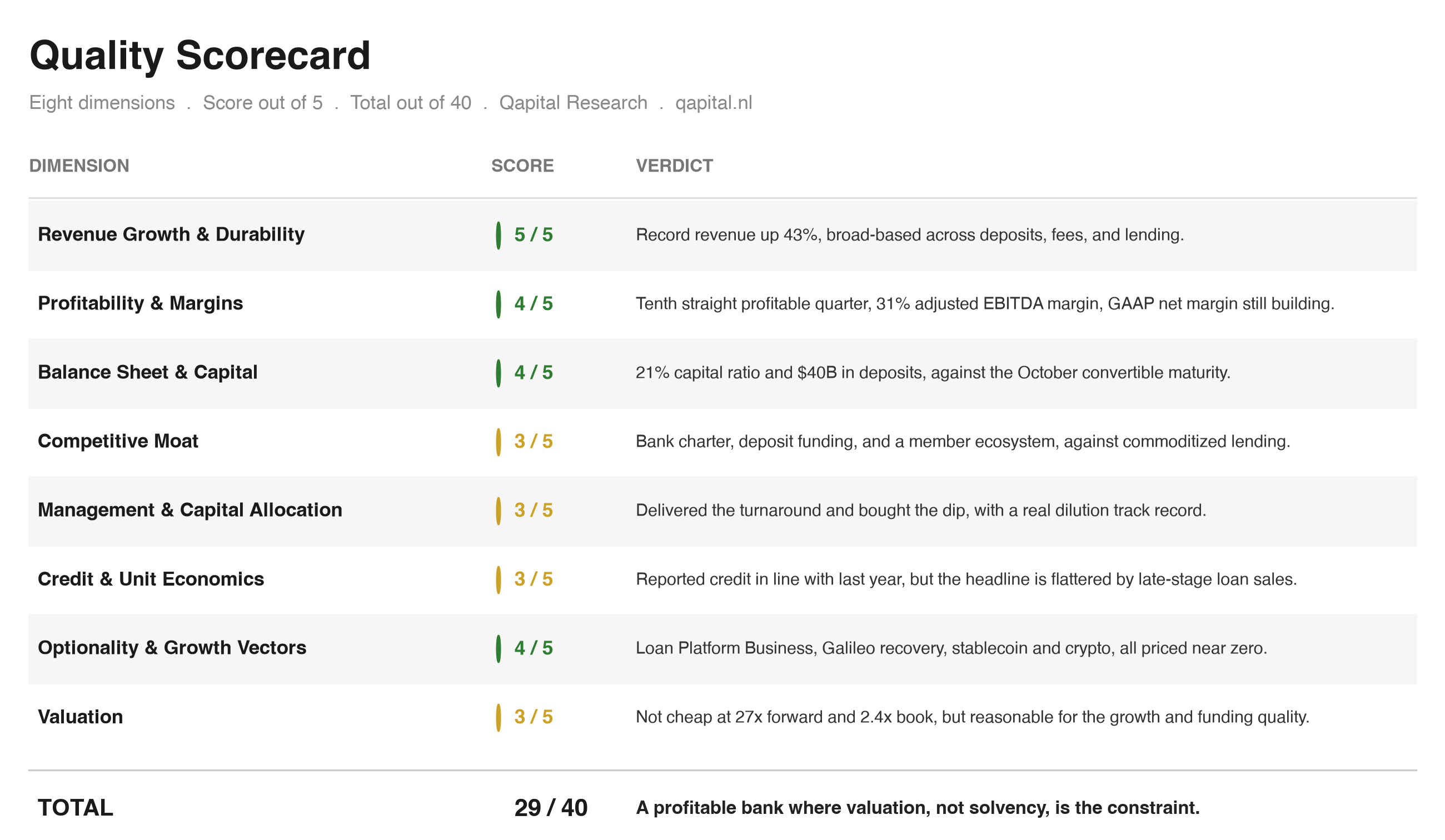
Quality Scorecard
Scenarios
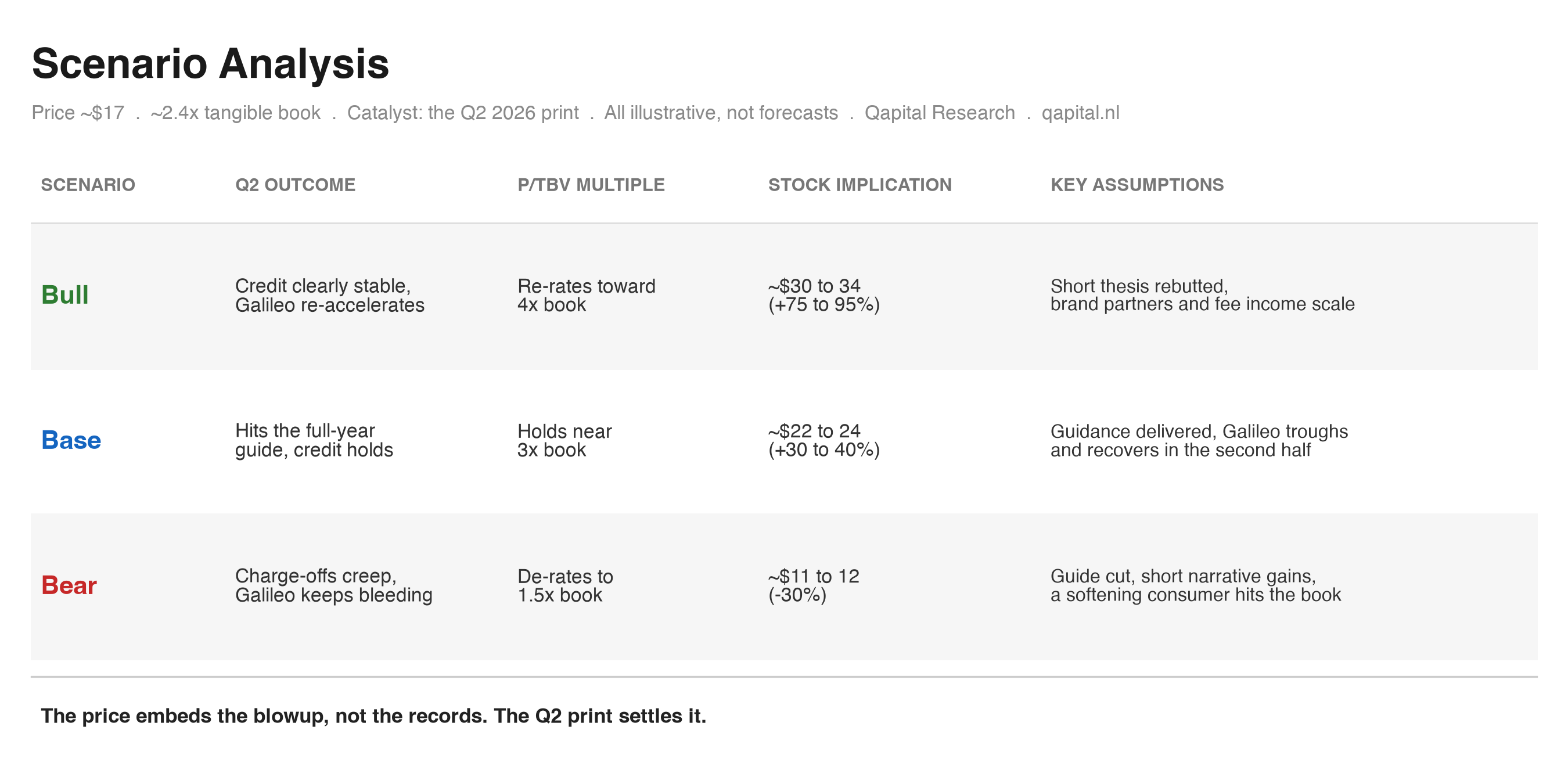
Bear case, roughly 11 to 12 dollars. The Q2 print shows personal-loan charge-offs climbing on both the headline and all-in basis, Galileo keeps shrinking, and management cuts full-year guidance. The Muddy Waters narrative gains credibility, a softening consumer pressures the whole loan book, and the multiple compresses toward 1.5 times tangible book. Roughly a third below today.
Base case, roughly 22 to 24 dollars. SoFi delivers its full-year guide of about 4.65 billion in adjusted revenue and around 0.60 in adjusted earnings per share, credit holds in line with last year, and Galileo troughs and recovers in the second half. Tangible book compounds past 8 dollars and the stock re-rates to a still-modest multiple of it. Roughly 30 to 40 percent above today.
Bull case, roughly 30 to 34 dollars. Credit proves clearly stable, directly rebutting the short thesis, Galileo re-accelerates as new brand partnerships land, the Loan Platform Business scales its fee income, and the market begins to price the deposit franchise as a bank rather than a risky lender. The stock reclaims its prior high and 2027 estimates move up. Roughly 75 to 95 percent above today.
The skew is the point. The downside is about a third, the base case is a third to the upside, and the bull case is the kind of double that high-quality businesses deliver when a fear proves unfounded. You are paid to take the Q2 test.
Sources and Disclosures
Figures are drawn from SoFi Technologies’ first-quarter 2026 earnings release, filed as a Form 8-K exhibit and dated April 29, 2026, for the quarter ended March 31, 2026. Market data, valuation multiples, short interest, and analyst targets are as of the June 23, 2026 close and are sourced from public market data providers. The Muddy Waters short report dated March 17, 2026 is referenced as an allegation that SoFi has publicly disputed, not as established fact.
This article is investment research and opinion for general information. It is not personalized investment advice, an offer, or a solicitation. Early-stage and high-multiple equities carry significant risk, including the permanent loss of capital. Do your own work and size positions accordingly. The author and Qapital Research may hold positions in the securities mentioned.